
Cardiogenic Shock in the Canadian Landscape: Key Concepts for the Practicing Clinician
Abstract
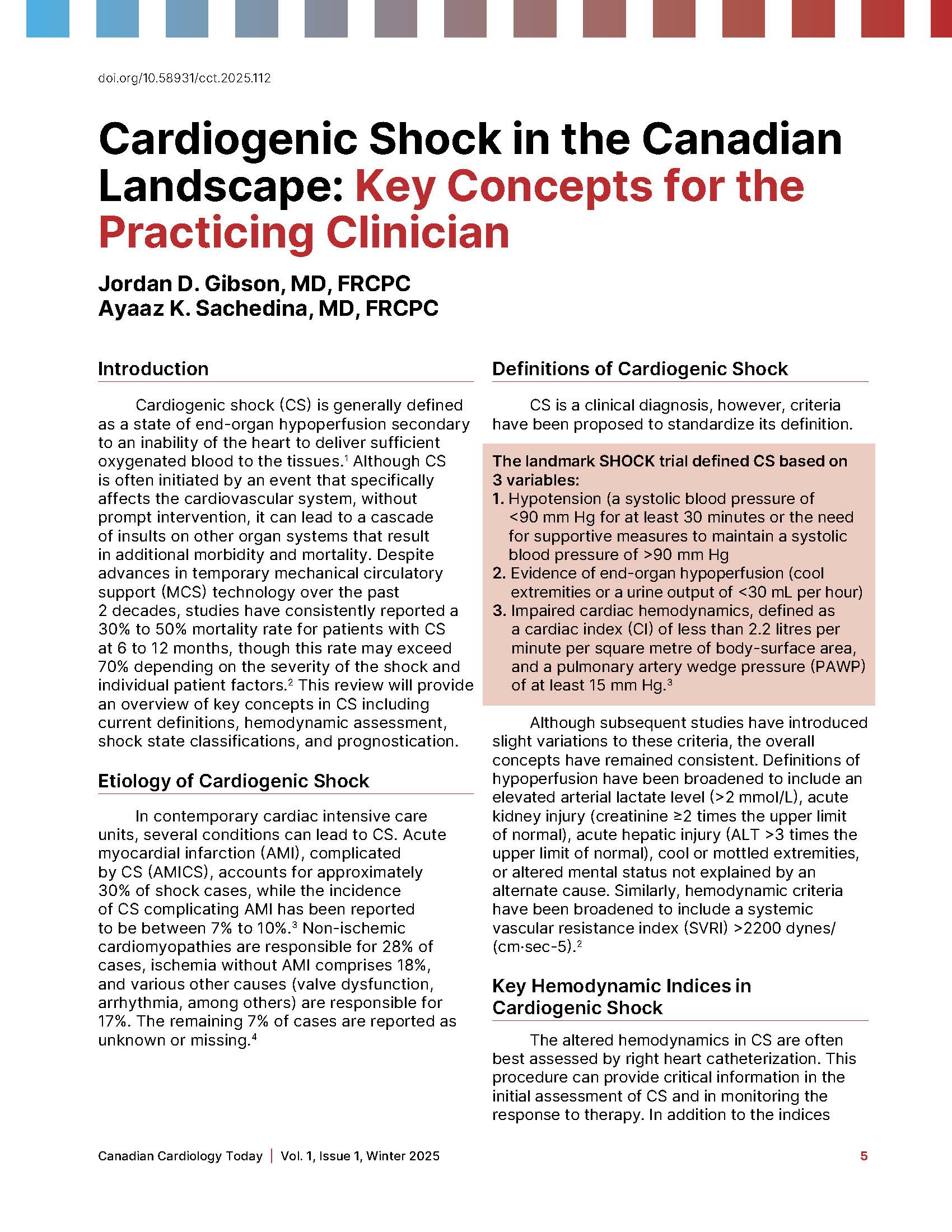
Cardiogenic shock (CS) is generally defined as a state of end-organ hypoperfusion secondary to an inability of the heart to deliver sufficient oxygenated blood to the tissues. Although CS is often initiated by an event that specifically affects the cardiovascular system, without prompt intervention, it can lead to a cascade of insults on other organ systems that result in additional morbidity and mortality. Despite advances in temporary mechanical circulatory support (MCS) technology over the past 2 decades, studies have consistently reported a 30% to 50% mortality rate for patients with CS at 6 to 12 months, though this rate may exceed 70% depending on the severity of the shock and individual patient factors. This review will provide an overview of key concepts in CS including current definitions, hemodynamic assessment, shock state classifications, and prognostication.
References
Jentzer JC, Pöss J, Schaubroeck H, Morrow DA, Hollenberg SM, Mebazaa A. Advances in the management of cardiogenic shock. Crit Care Med. 2023;51(9):1222–1233.
Waksman R, Pahuja M, Van Diepen S, Proudfoot AG, Morrow D, Spitzer E, et al. Standardized definitions for cardiogenic shock research and mechanical circulatory support devices: Scientific Expert Panel From the Shock Academic Research Consortium (SHARC). Circulation. 2023;148(14):1113–1126.
Hochman JS, Sleeper LA, Webb JG, Sanborn TA, White HD, Talley JD, et al. Early revascularization in acute myocardial infarction complicated by cardiogenic shock. N Engl J Med. 1999;341(9):625–634.
Berg DD, Bohula EA, Van Diepen S, Katz JN, Alviar CL, Baird-Zars, VM, et al. Epidemiology of shock in contemporary cardiac intensive care units: data from the Critical Care Cardiology Trials Network Registry. Circulation: Cardiovascular Quality and Outcomes 2019;12(3):e005618.
Mendoza DD, Cooper HA, Panza JA. Cardiac power output predicts mortality across a broad spectrum of patients with acute cardiac disease. Am Heart J. 2007;153(3):366–370.
Zern EK, Wang D, Rambarat P, Bernard S, Paniagua SM, Liu EE, et al. Association of pulmonary artery pulsatility index with adverse cardiovascular events across a hospital-based sample. Circ Heart Fail. 2022;15(2):e009085.
Cesini S, Bhagra S, Pettit SJ. Low pulmonary artery pulsatility index is associated with adverse outcomes in ambulatory patients with advanced heart failure. J Card Fail. 2020;26(4):352–359.
Kochav SM, Flores RJ, Truby LK, Topkara VK. Prognostic impact of pulmonary artery pulsatility index (PAPi) in patients with advanced heart failure: insights from the ESCAPE trial. J Card Fail. 2018;24(7):453–459.
Merdji H, Levy B, Jung C, Ince C, Siegemund M, Meziani F. Microcirculatory dysfunction in cardiogenic shock. Ann Intensive Care. 2023;13(1):38.
Wijntjens GW, Fengler K, Fuernau G, Jung C, den Uil C, Akin S, et al. Prognostic implications of microcirculatory perfusion versus macrocirculatory perfusion in cardiogenic shock: a CULPRIT-SHOCK substudy. Eur Heart J Acute Cardiovasc Care. 2020;9(2):108–119.
Baran DA, Grines CL, Bailey S, Burkhoff D, Hall SA, Henry TD, et al. SCAI clinical expert consensus statement on the classification of cardiogenic shock: This document was endorsed by the American College of Cardiology (ACC), the American Heart Association (AHA), the Society of Critical Care Medicine (SCCM), and the Society of Thoracic Surgeons (STS) in April 2019. Catheter Cardiovasc Interv. 2019;94(1):29–37.
Thayer KL, Zweck E, Ayouty M, Garan AR, Hernandez-Montfort J, Mahr C, et al. Invasive hemodynamic assessment and classification of in-hospital mortality risk among patients with cardiogenic shock. Circ: Heart Fail. 2020;13(9):e007099.
Jentzer JC, van Diepen S, Barsness GW, Henry TD, Menon V, Rihal CS, et al. Cardiogenic shock classification to predict mortality in the cardiac intensive care unit. J AM Coll Cardiol. 2019;74(17):2117–2128.
Lawler PR, Berg DD, Park J-G, Katz JN, Baird-Zars VM, Barsness GW, et al. The range of cardiogenic shock survival by clinical stage: data from the Critical Care Cardiology Trials Network Registry. Critical Care Med. 2021;49(8):1293–1302.
Yerasi C, Case BC, Pahula M, Ben-Dor I, Waksman R. The need for additional phenotyping when defining cardiogenic shock. JACC Cardiovasc Interv. 2022;15(8):890-895
Jentzer JC, Rayfield C, Soussi S, Berg DD, Kennedy JN, Sinha SS, et al. Advances in the staging and phenotyping of cardiogenic shock: Part 1 of 2. JACC: Adv. 2022;1(4):100120.
Jentzer JC, Rayfield C, Soussi S, Berg DD, Kennedy JN, Sinha SS, et al. Machine learning approaches for phenotyping in cardiogenic shock and critical illness. JACC: Adv. 2022;1(4):100126.
Baran DA, Long A, Badiye AP, Stelling K. Prospective validation of the SCAI shock classification: single center analysis. Catheter Cardiovasc Interv. 2020;96(7):1339–1347.
Schrage B, Dabboura S, Yan I, Hilal R, Neumann JT, Sorensen NA, et al. Application of the SCAI classification in a cohort of patients with cardiogenic shock. Catheter Cardiovasc Interv. 2020;96(3):E213-E219
Hanson ID, Tagami T, Mando R, Kara Bella A, Dixon SR, Timmis S, et al. SCAI shock classification in acute myocardial infarction: Insights from the National Cardiogenic Shock Initiative. Catheter Cardiovasc Interv. 2020;96(6):1137–1142.
Jentzer JC, Van Diepen S, Patel PC, Henry TD, Morrow DA, Baran DA, et al. Serial assessment of shock severity in cardiac intensive care unit patients. J Am Heart Assoc. 2023;12(23):e032748.
Kapur NK, Kanwar M, Sinha SS, Thayer KL, Garan AR, Hernandez-Montfort J, et al. Criteria for defining stages of cardiogenic shock severity. J Am Coll Cardiol. 2022;80(3):185–198.
Pham HM, Van HD, Hoang LB, Phan PD, Tran VH. Distribution and 24-hour transition of SCAI shock stages and their association with 30-day mortality in acute myocardial infarction. Medicine (Baltimore). 2023;102(37):e34689.
Morici N, Frea S, Bertaina M, Sacco A, Corrada E, Sorini Dini C, et al. SCAI stage reclassification at 24 h predicts outcome of cardiogenic shock: insights from the Altshock‐2 registry. Catheter Cardiovasc Interv. 2023;101(1):22–32.
Wang JI, Lu DY, Mhs, Feldman DN, McCullough SA, Goyal P, et al. Outcomes of hospitalizations for cardiogenic shock at left ventricular assist device versus non–left ventricular assist device centers. J Am Heart Assoc. 2020;9(23):e017326.
Papolos AI, Kenigsberg BB, Berg DD, Alviar CL, Bohula E, Burke JA, et al. Management and outcomes of cardiogenic shock in cardiac ICUs with versus without shock teams. J Am Coll Cardiol. 2021;78(13):1309–1317.
Lee F, Hutson JH, Boodhwani M, McDonald B, So, D, De Roock S, et al. Multidisciplinary code shock team in cardiogenic shock: a Canadian centre experience. CJC Open. 2020;2(4):249–257.
Moghaddam N, Van Diepen S, So D, Lawler PR, Fordyce CB. Cardiogenic shock teams and centres: a contemporary review of multidisciplinary care for cardiogenic shock. ESC Heart Fail. 2021;8(2):988–998.
Thiele H, Zeymer U, Neumann F-J, Ferenc M, Olbrich H-G, Hausleiter J, et al. Intra-aortic balloon counterpulsation in acute myocardial infarction complicated by cardiogenic shock (IABP-SHOCK II): final 12 month results of a randomised, open-label trial. Lancet. 2013;382(9905):1638–1645.
Thiele H, Zeymer U, Akin I, Behnes M, Rassaf T, Mahabadi AA, et al. Extracorporeal life support in infarct-related cardiogenic shock. N Engl J Med. 2023;389(14):1286–1297.
So DYF, Bagai A, Van Diepen S, Fordyce CB, Liu S, Avram R, et al. A pan-Canadian survey of cardiogenic shock management: a report from the Canadian Cardiovascular Research Collaboratory (C3) Cardiogenic Shock Working Group. Canadian J Cardiol. 2022;38(11):1732–1735.
Van Diepen S, Zheng Y, Senaratne JM, Tyrrell BD, Das D, Thiele H, et al. Reperfusion in patients with ST-segment–elevation myocardial infarction with cardiogenic shock and prolonged interhospital transport times. Circ Cardiovasc Interv. 2024;17(2):e013415. [
Aslam MI, Jani V, Lin BL, Dunkerly-Eyring B, Livingston CE, Ramachandran A, et al. Pulmonary artery pulsatility index predicts right ventricular myofilament dysfunction in advanced human heart failure. Eur J Heart Fail. 2021;23(2):339–341.
Kanjanahattakij N, Sirinvaravong N, Aguilar F, Agrawal A, Krishnamoorthy P, Gupta S. High right ventricular stroke work index is associated with worse kidney function in patients with heart failure with preserved ejection fraction. Cardiorenal Med. 2018;8(2):123–129.
Grodin JL, Drazner MH, Dupont M, Mullens W, Taylor DO, Starling RC, et al. A disproportionate elevation in right ventricular filling pressure, in relation to left ventricular filling pressure, is associated with renal impairment and increased mortality in advanced decompensated heart failure. Am Heart J. 2015;169(6):806–812.
Barker M, van Diepen S, Granger CB, Wong GC, Baird-Zars VM, Park JG, et al. Differences in care and outcomes in cardiogenic shock in cardiac intensive care units in the United States and Canada: CCCTN Registry insights. Can J Cardiol. Published online January 20, 2025. doi: 10.1016/j.cjca.2025.01.012
Downloads
Published
How to Cite
Issue
Section
License
Copyright (c) 2025 Canadian Cardiology Today

This work is licensed under a Creative Commons Attribution-NonCommercial-NoDerivatives 4.0 International License.